exhibition histories:
some apprehensions and anticipations
Notes from the 2020 Curatorial Workshop | 23-26 June 2020 |Bucharest Biennale.
In the last decade or so of the 20th Century, a series of works created a new focus around exhibition as an object of sociological, art historical and critico-theoretical scholarship, with key works by Tony Bennet, Carol Duncan, Bruce Altshuler and Reesa Greenberg et al. More recently, in the second decade of the 21st Century, the Afterall Exhibition Histories series, realized by University of the Arts London, in partnership with Bard CCS and Asia Art Archive among others, has generated a very diverse set of exhibition studies that speaks to a very different geopolitical frame from that of the 1990s work, while mobilizing a range of disciplines, including: criticism, art history, cultural studies, and critical social theory.
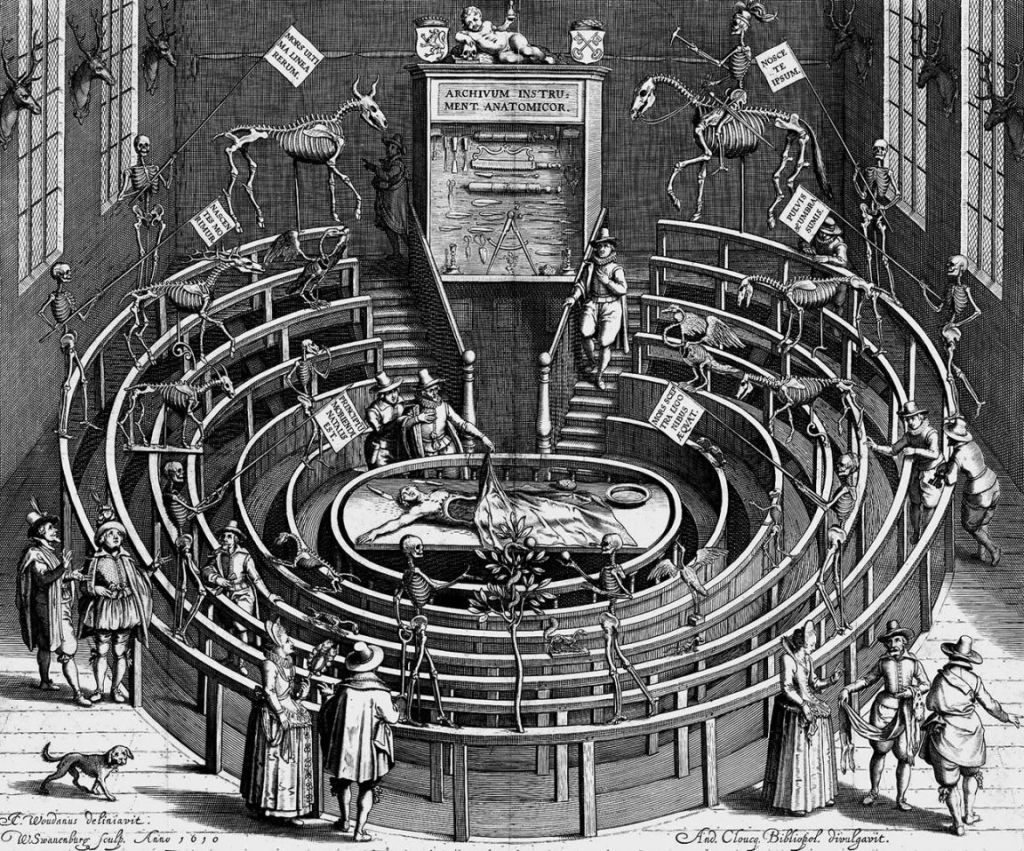
A different trajectory of exhibition histories has been marked out by the research project Theater, Garden, Bestiary: A Materialist History of Exhibitions (at University of Applied Sciences and Arts of Western Switzerland & University of Art and Design Lausanne research project) which announces itself as working at a distance from what it calls “today’s flurry of studies related to curating” seeking to “draft a history of exhibitions sourced from a wide corpus reaching beyond the framework of artistic institutions.”
Writing sometime around 2010 Nikolett Erőss, in an entry of the Curatorial Dictionary on ‘Exhibition Display‘ argued that: “It is important to note that the new discipline of exhibition history—embedded in a broader tendency towards critically conditioned understandings of the past—has been worked out in the context of post-war Western Europe and the United States and is thus framed by the operational system of late capitalism. However, many of its historical and critical observations also hold true when applied to the former Soviet Bloc. In order to establish a context-specific research in Eastern Europe, a constant re-evaluation of the theses formulated in Western theories is needed.”
In 2017, a two day symposium on ‘Contextualising the Art Salon in the Arab Region‘ took place in Beirut under the aegis of the Orient-Institut Beirut and the Nicolas Ibrahim Sursock Museum. The agenda that many of the contributions advanced, was to situate the transfer of salon exhibition culture within the analysis of colonial power relations and also within the transnational exchanges of the colonized. Nancy Demerdash-Fatemi in her contribution on ‘The Aesthetics of Tastemaking in (and out of) the Algerian Salon’ begins by noting that right from “the onset of the French occupation and subsequent settler colonization of Algeria in 1830, several arts institutions emerged in tandem with the colonial administration’s need for cultural reconnaissance in situ.” This positions the exhibition as part of an apparatus of colonial capture and extraction not only in the metropolitan centre (in the ethnographic and natural history museums, and in the world expositions) but also in the colony itself.
Annette Bhagwati, writing in the volume Curatorial Things: Cultures of the Curatorial (2019) under the heading ‘Modes of Aesthetic Display in African Art’ proposes to counter-pose the study of ‘modes of aesthetic display’ to the ‘Western’ paradigm of the exhibition. This is a complicated move, as it still operates a frankly avowed Eurocentric norm by seeking comparable cultural instances and equivalent forms of the exhibition construct within diverse African cultural contexts. This might be contrasted with Chimurenga’s longstanding project of re-imagining the histories of pan-African cultural politics, where the unit of historical analysis is not the exhibition, even though the Chimurenga Library series has recently realized a volume on Festac ’77 as part of the Afterall Exhibition Histories series.
What has been gathered below is a small sampling of online resources that tries to suggest the many different paths that exhibition histories traverses. The selection of the material is both ad hoc and motivated in as much as the material is: (i) available online (a matter of contingency) and (ii) is deemed to provide an exemplary instance of a style of historical work on exhibition, or give ready access to some of the debates and themes within the development of exhibition histories as a tentative and multiply conceived interdisciplinary field.
Adajania, Nancy (2014) “Dashrath Patel’s non-aligned alignments”, in INHERITANCES: A symposium on the problems and possibilities of India’s museums. Adajania profiles the multimedia experimentation avant la lettre of “the polymath artist, designer and institution builder” Dashrath Patel in her account of the prehistory of new media art in India. She describes her intervention as “entangled … with the history of exhibition design and the world expos, nationalist politics, Cold War intercultural encounters and grassroots activism” and her intention as being “to elude many default binaries, including those of art versus commerce, art versus activism, and old versus new media.”
Bremer, Maria (2015) “Modes of Making Art History: Looking Back at documenta 5 and documenta 6”. An intervention into the debates on the historical study of the exhibition that seeks to identify potential “blind spots of art history as exhibition history.”
Dirkx, Maaike (2015) “Fit for a Queen: Amsterdam’s 1898 Rembrandt exhibition” An idiosyncratic scholarly consideration of the 1898 Stedelijk Museum, Amsterdam, Rembrandt exhibition described as “the first ever exhibition dedicated to a single Old Master.” Presented as a blog entry, the study provides an interesting sense of the modernity of the “old master” in display, and the survey exhibition as an engine of discourse.
Boersma, Linda and Van Rossem, Patrick (2015) Rewriting or Reaffirming the Canon: Critical Readings of Exhibition History, Stedelijk Studies, Issue 2 (Spring). An issue of the Stedelijk Studies journal dedicated to the question of exhibition history, providing a sampling of perspectives and several responding to the perceived impact of Bruce Altshuler’s work in setting up certain habits of approach. See the contrast proposed with the earlier issue of VECTOR edited by Catalin Gheorghe and Cristian Nae (2014), as listed and commented below..
Fletcher, Pamela M. (2007) “Creating the French Gallery: Ernest Gambart and the Rise of the Commercial Art Gallery in Mid-Victorian London”, Nineteenth-Century Art Worldwide 6, no. 1 (Spring 2007), An interesting tight focus historical essay on the emergence of the “French Gallery” in London in the mid-19th Century as “a full-time space devoted to the exhibition and sale of contemporary art”. This focus is taken as mapping a change from the 1840s when “exhibitions of contemporary art were held in rented premises by a constantly changing roster of associations, print sellers, and auctioneers” to the 1860s when “an established gallery culture with dedicated spaces and regular exhibitions increasingly defined the market for contemporary art.”
Gheorghe, Catalin and Nae, Cristian (eds.) (2013) Exhibiting The “Former East”: Identity Politics and Curatorial Practices After 1989 / A Critical Reader, VECTOR: Critical Research in Context. The Romanian language version here. A collection of essays by scholars, theorists and curators mapping a wide range of issues in the cultural-political framing of “Former East” in exhibition and curatorial practice. The project manifests a practice of thinking exhibitions historically so as to produce genealogies for contemporary critical practices, and so as to trouble some of the clichés that installed themselves in the production of cultural geographies of identity in the “East”. There are interesting contrasts between the Stedelijk Studies volume of 2015 and this edition of VECTOR: Critical Research in Context, two years earlier, both in the terms of criticism employed, and in the geopolitical positioning of singular versus multiple historical narratives.
Mainardi, Patricia (1991) “Courbet’s Exhibitionism” Gazette des beaux-arts, per. 6, 8, no. 1475 (December) 253–66 (Also here: http://faculty.winthrop.edu/stockk/modernism/COURBET.pdf ) Mainardi (along with Elizabeth Holt) was one of the few English language art historians to seriously address the question of the art exhibition as historical concern before the 1990s rise in interest in this as an object of historical scholarship. This paper gives a fascinating exploration of Courbet’s transgression of the lines between exposition and exhibition, and the moral economy of display in mid-19th Century Paris.
Mathur, Saloni (2019) “Why Exhibition Histories?” A Conversation Piece from the British Art Studies series that draws together a group of contributors to respond to this question in the context of an issue focused on the colonial/postcolonial entanglements of the metropolitan centre and the colonies: “London, Asia, Exhibitions, Histories” Lucy Steeds from the Afterall Exhibition Histories platform, opens her contribution by describing her work “within exhibition histories—writing, editing, teaching, and curating—aims both to entangle and to open up art histories. I do not see the field in which I operate as demanding a shift away from the artwork, although this neglectful tendency is sometimes aridly apparent. Instead, I’d suggest an insistence on art seen in relation and in public. The practice of exhibition histories does not focus so much on the isolated, intact artwork but, rather, approaches it in conjunction and puts it into question. How does art develop dialogues with adjacent art—and non-art—with a host environment, institutional ideologies, and among geopolitically and historically particular publics?”
Normand, Vincent (2016) “The Eclipse of the Witness: Natural Anatomy and the Scopic Regime of Modern Exhibition-Machines” L’Internationale Online, Normand makes good on the promise of Theater, Garden, Bestiary: A Materialist History of Exhibitions to develop a materialist approach to exhibition histories beyond the terms of ‘art’ as the horizon concept. He asks “how to actualise what Tony Bennett (1988) coined as “the exhibitionary complex” while moving beyond mere sociological description, and engaging the epistemological and ontological dimensions of the very gesture of exhibition?” He continues: “While today the history of exhibitions is undergoing renewed interest (be it as an object of hyper self-reflexivity for curators, or as an institutional narrative based on historical markers, or more positively as a privileged object of contemporary philosophies attempting to redefine the mode of existence of the art object), it is becoming a discipline roughly divided between art-historical analyses tackling the exhibition as a medium to be deconstructed, and historicist projects mobilising it as a reified framework to be staged as such, or escaped from altogether. In that context, it seems important to maintain a dialectical engagement with the exhibition as a genre, i.e. as a generic object of modernity, in order to grasp it in a fully historical way, that is to say as a ongoing tactical field for the future of art.”
Ray, William (2004) “Talking About Art: the French Royal Academy Salons and the Formation of the Discursive Citizen” in Eighteenth-Century Studies, Volume 37, Number 4, Summer, pp. 527-552. (Johns Hopkins University Press) An intriguing account of the space of salon exhibition as a disciplinary matrix and pre-Republican public sphere.
Vogel, Felix (2014) “Notes on exhibition history in curatorial discourse” OnCurating.org. No. 21. “I will limit myself almost exclusively to the history of exhibitions in curatorial discourse, this is not primarily intended to create a distinction of judgment between this discourse on the one hand, and that of academic art history on the other. Rather, it is a necessary limitation to strengthen and focus my argument. Such a focus can render territorial strategies more visible, which means asking precise questions such as: who defines concepts and terminologies? Who determines the canon and therefore the history of exhibitions and in what ways? I also suspect that an exhaustive examination of this discourse on the exhibition provides some clues to the issue of the homogenization of exhibition formats, which also allows us to draw some retrospective conclusions about the supposedly transnational format of the large-scale international exhibition since the end of the 1980s.”
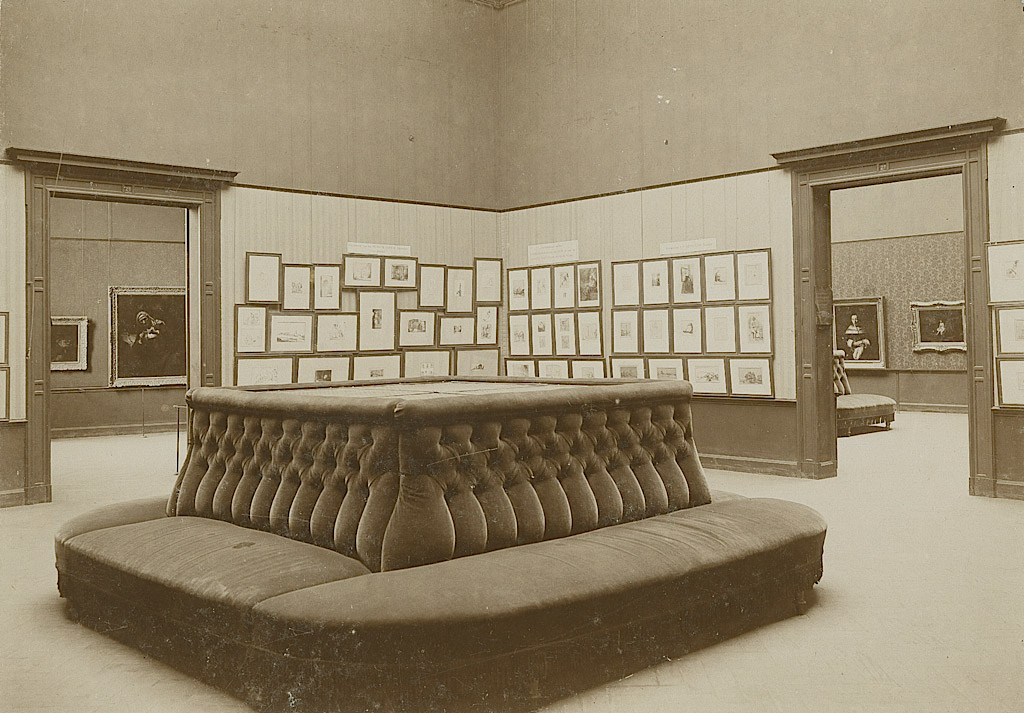
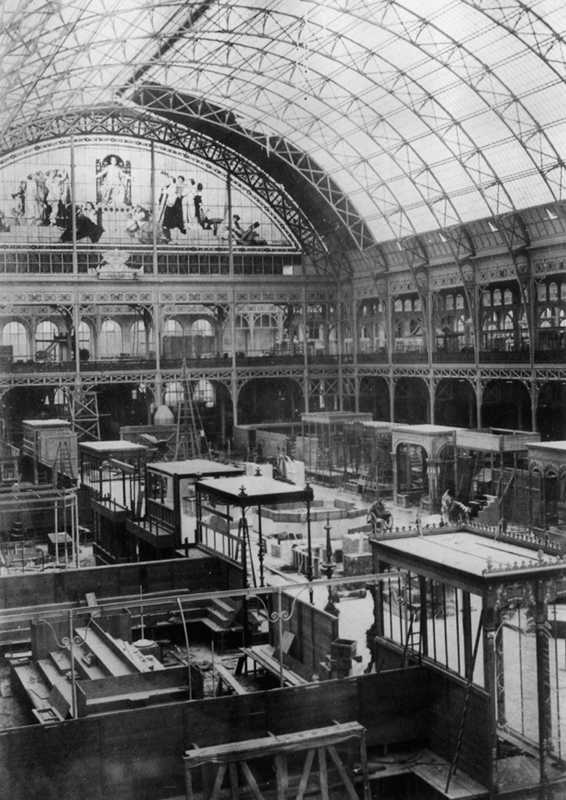
SEEING THINGS: The following four sources that provide visual materials that suggest something of the 19th Century metropolitan innovation in architectures and protocols of display.
Boyer, Laura (2002) “Robert J. Bingham, photographe du monde de l’art sous le Second Empire” Études photographiques, (November) No. 12, A French language contribution to the history of photography that provides intriguing glimpses of the orchestration of new visual regimes of display in the views of L’Esposition Universelle (1855) and an installation shot by R. J. Bingham.
Mathieu, Caroline (2007) “Universal Exhibitions, Real and Utopian Architecture”
Musée d’Orsay (2006) “A Review of the Universal Exhibitions from 1851 to 1900”
Ward, Martha (1991) “Impressionist Installations and Private Exhibitions”, The Art Bulletin, Vol. 73, No. 4 (December), pp. 599-622
 exhibition.school