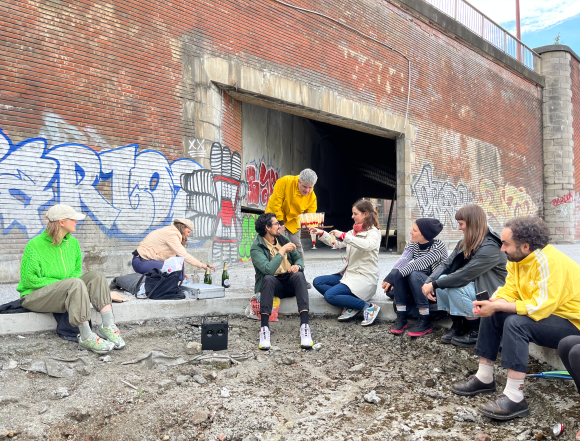
This page provides supplementary information on the course Commissioning and Curating Contemporary Public Art 30 ECTS, offered by HDK-Valand, University of Gothenburg, and an associated initiative of the Centre for Art and the Political Imaginary (CAPIm). Here is a link to a report n the course by a previous student.
This course is part of a wider set of courses on art and the political imaginary that are associated initiatives of Centre for Art and the Political Imaginary (CAPIm), the first Swedish Centre of Excellence in the field of Artistic Research.
ABOUT THE COURSE
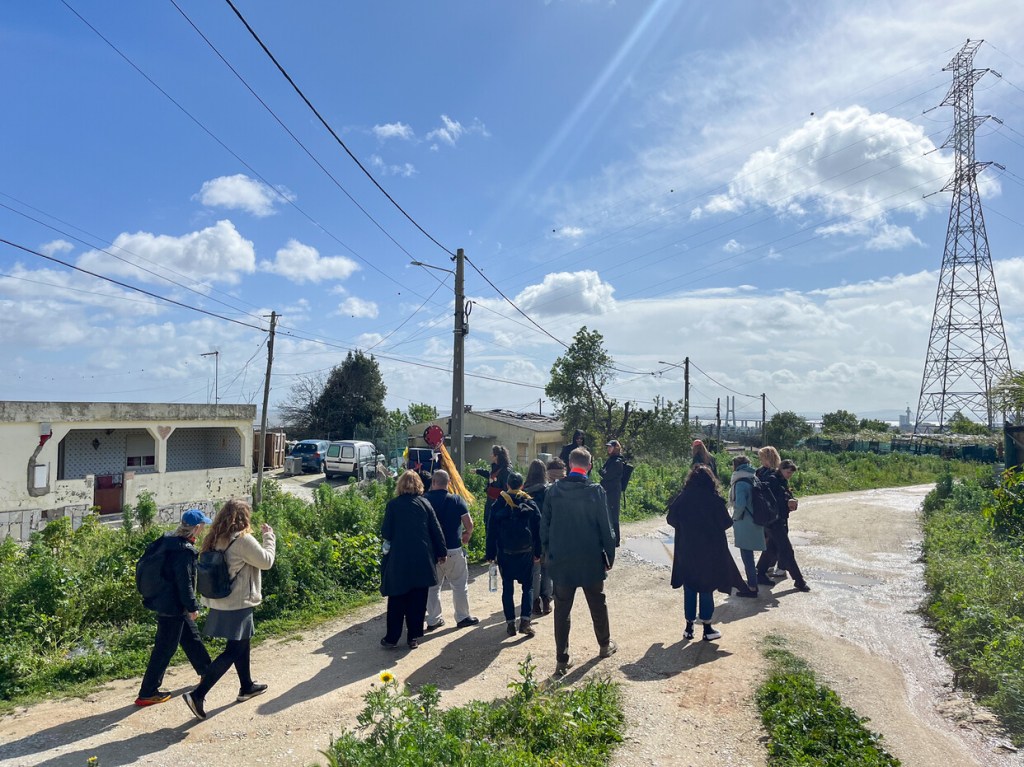
This is a one-year, long-distance, part-time course, at advanced/masters level, introducing key practices and debates in working with art in the public realm. A continuing professional development course for curators, commissioners, policy-makers, artists, communities, activists, planners, architects and other professionals interested in the questions of commissioning, curating, and maintaining / de-commissioning contemporary public art. This international course, delivered in English is based on a combination of distance education and participation in at least two intensive workshops (from a set of four). Workshops in 2025 will be in Lisbon, Portugal (March 19–21), Bucharest,
Romania (May 14-16), Riga, Latvia (October 17–19) and Gothenburg, Sweden (November 19–21).
The course is free within the EU/EEA area: No fees for EU and EEA citizens, Swedish residence permit holders and exchange students. Students are responsible for their own costs of attending the two selected intensive workshops. Admission is based on a letter of intention in English stating why you wish to attend the course and an updated CV.
Teaching team: Jason E. Bowman, Kerry Guinan, Kerstin Bergendal, Kjell Caminha, Maddie Leach, Mick Wilson
ABOUT THE CONTENT
What is the nature of public art? What do the policy-makers, commissioners, curators, artists and others working with public art need to know about this expanded field of practice? What are the processes and frameworks that operate when art is created in, and for, public space? How is public art implicated within spatial imaginaries of rural, urban, exurban, infrastructure, development and the touristic gaze? What do communities wishing to invite public art into their environments, or wishing to instigate public art commissions, need to know in order to pursue their desires and ambitions? Who can commission public art? Who is it commissioned for? What about decommissioning? What about failure? What are the spaces of “publicness” in an era of climate change, population displacement, digital networks, war, and the privatisation of space? How can curators, commissioners, communities, artists, and other practitioners effectively move between ideas and ideals of public culture, and the pragmatic contexts of actual decision-making, production, procurement, installation, and planning processes? What, if any, are the possible relationships between public art, local democracy and the political imaginary? Is publicness a Euro-centric construction of colonial-modernity?
These questions are approached through conflicting perceptions of public space, public culture, and the contested themes of “the public sphere”. We emphasize the interaction of theory and practice, so as not to privilege theory over practice, but rather to look at how different perspectives—rooted in practice as well as informed by theoretical analysis—connect to different possibilities in realising art as an integral part of public life.
PRACTICALITIES
Online sessions typically on Tuesdays and Thursdays, 4pm Swedish time (CET). You require stable internet access and headphones. Content from workshops may be posted online for participants. Participation in workshops means that contributions to discussion may be recorded for this purpose.
COSTS
Students are responsible for their own costs attending workshops.
APPLY
September 16 to October 15 with letter of intention (in English) stating your reasons to study, maximum 350 words and recent CV. Admission criteria: (i) clarity of purpose in attending course, as evidenced in letter; (ii) capacity to actively contribute to the group dialogue, evidenced in letter. Applications: University Admissions (international applicants) and antagning.se (applicants in Sweden).
 exhibition.school