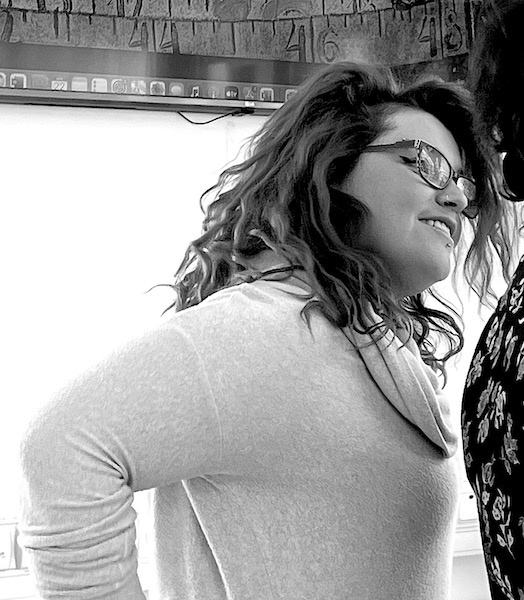
Sara Khayat is a feminist graphic designer, illustrator, and visual artist from Syria. She was born in Damascus and studied graphic design at the International University for Science and Technology (IUST Syria), located in the city of Ghabagheb (غَبَاغِب).
Khayat’s work is focused on women’s, LGBTQI+, and refugee rights, using illustration and graphic design to support a wide range of social justice causes, including challenging gender stereotypes and gender-based violence. Sara has worked for and with a variety of organisations across Turkey, Lebanon, and Europe. Since the beginning of the Syrian Civil War in 2011, Khayat has worked on documenting human rights violations by all parties involved in the conflict and the oral histories of women detained by the Syrian regime.
Sara Khayat has been involved in campaigns and advocacy missions through organisations such as Right to Remain UK, and Liberated T, sponsored by the Institute of War and Peace Reporting, amongst others. As a freelance designer, Sara has worked with several civil society organisations, including the Syrian Child Protection Network, The A Project, and Dammeh, focused on the rights of children, women, and LGBTQI+ people. K
More recently, Khayat has been involved in designing visual materials for books and research for organisations which document gender-based violence in Syria. Her work has featured in various exhibitions and publications, including during the first Global Refugee Forum in Geneva (2019), in the ’Dream Sequences’ exhibition in Amsterdam (2019), and in the October 2020 issue of Eko magazine.
Due to the focus and the nature of her work, Sara Khayat was forced to flee Syria for Turkey in 2015. At the beginning of 2023, Sara arrived in Sweden and became the ICORN resident in Gävle City of Refuge. She is the third ICORN resident Gävle has hosted.
In Sweden, Sara continues her work, including an art project exploring the connection between the human body and its surrounding, and plans to collaborate with local artists working on mutual topics of interest.
about the work:
“My Journey with Niham: Eating is Pain, Not Pleasure“

1. I was overweight, very quiet, and insecure during my teenage years, feeling worthless, ugly, and unlovable. Therefore, I thought it would be good to punish myself by vomiting after consuming any kind of food, as if it was a punishment for my flaws and a way to cleanse my body of fats that represented everything I hated about myself. For me, obesity was synonymous with ugliness and laziness, while thinness was synonymous with beauty and love. Over time, the numbers on the scale became a measure of my mental and emotional state. Most people do not realize that when you indulge in overeating, you are trying to fill an emotional void within you, and the vomiting process that follows is not just about getting rid of the food, but also about getting rid of everything that hurts you without knowing how to express it. Therefore, vomiting becomes your only refuge.
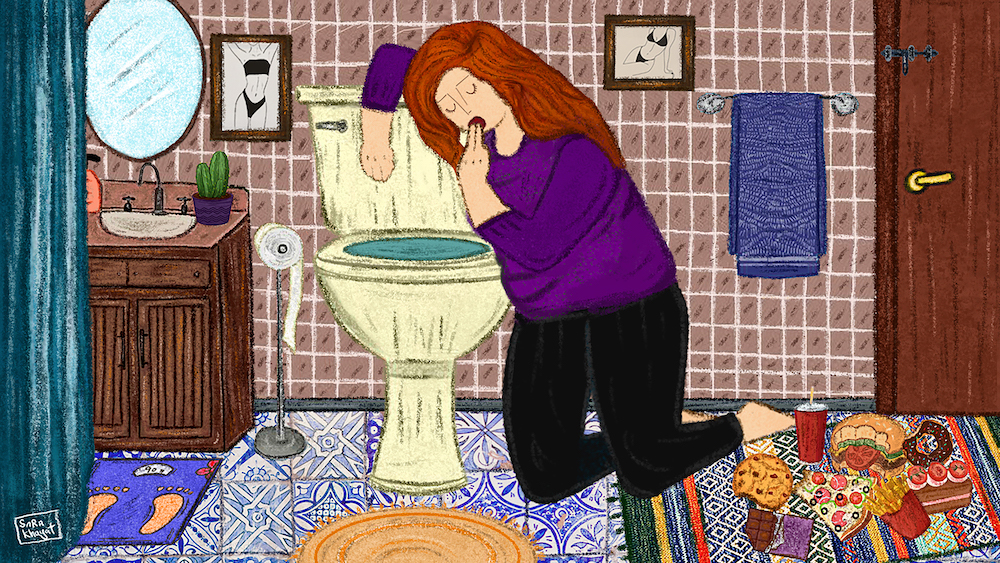
2. Binge eating disorder is a vicious cycle of pain, an endless cycle of excessive eating in a short period of time until reaching a point of discomfort and then engaging in purging everything that has been consumed. Despite the pain and distress, my body craved it over and over again. I would eat without deriving any pleasure from it and then purge afterwards. Binge eating became a part of my daily life for a long time. When someone would tell me that I had lost weight, I felt a sense of pride. Whenever I met someone, my weight quickly became the focus of the conversation, which compelled me to repeat the process of purging in order to lose more weight.
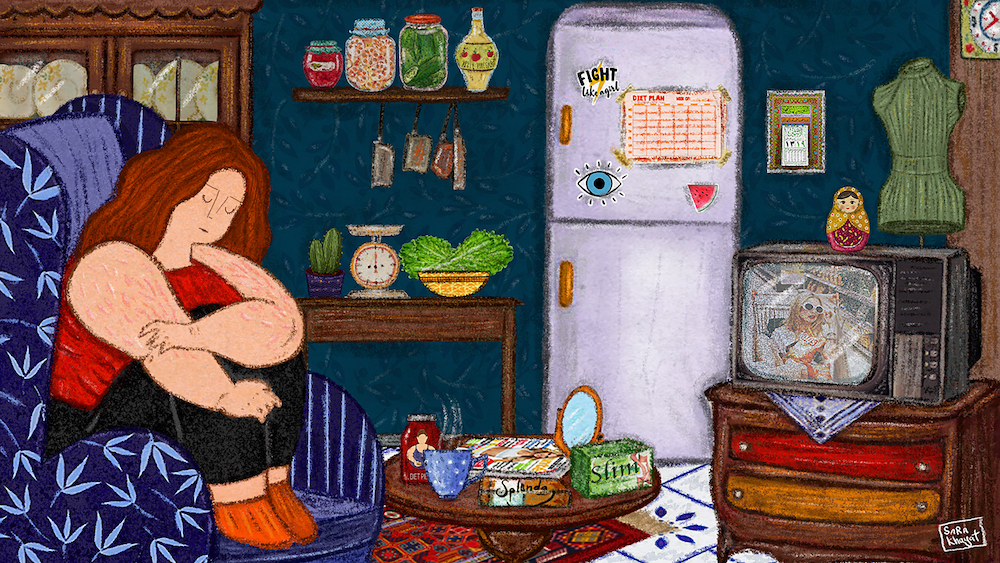
3. It appears that the beauty standards imposed by traditional societies are not the sole factor responsible for the prevalence of eating disorders; rather, our upbringing in the family and school, as well as the methods of evaluating our worth in capitalist systems, also play a role in this process. In these systems, I learned to perceive objects based on their material value, and within these frameworks, I began to view myself as a measurable entity, something to be acquired and compared to others.
I couldn’t talk to anyone about my experiences during my adolescence, and I couldn’t find any helpful resources anywhere, especially when the media presented physical standards that differed from my own body. At that time, I didn’t know if there was a name for my struggles. I believed the fault was mine. Consequently, I tried every product, medication, diet, or recipe that could lead to a solution. This resulted in the disruption of my menstrual cycle for a period of time, hair loss, worsening depression, and an intensified anger towards my body, which didn’t know how to cope with these pressures except by gaining even more weight.

4. A journey to recovery has been long and is still ongoing. In addition to breaking the cycle of hunger and closed vomiting, I had to reconcile with my body and take care of it, no matter what form it takes. In my battle with this disorder, drawing played a crucial role, as it helped me replace the painful and exhausting emotional purging with lines, shapes, and colors covering the pages.Until recently, I didn’t know that my body was my choice. It had always been a public domain for everyone to comment on and mock its imperfections. I remember the last time I faced such a situation, I suddenly screamed loudly, causing my entire family to fall into silence and look at me in astonishment. This incident happened three years ago, and it was the first time in my life I said that I don’t like anyone touching me. In that moment, I felt that I could appreciate and respect my body.Now, I consider myself a survivor of all the violence that was inflicted upon my body.Today, I love my body unconditionally and I try to exercise regularly to support it and thank it for enduring the pain and pressures, compensating for periods of agony. I constantly remind myself that I deserve complete love and safety.
WHAT’S THE MEANING OF THE HOME FOR A SYRIAN REFUGEE WOMAN IN EXILE?
In March, I went through a harsh experience trying to travel from Turkey. which made me think about all the stages I went through asking for asylum. Each stage from Syria, Lebanon, Turkey and Dubai had its difficulties and its problems, I tried to reflect this long journey searching for a home in my drawings. It is a story about
Asylum and our Syrian identity which is govern many of our experiences, and our relationship with ourselves and with others. Very happy and proud to share it with you. I did it as an artistic project with JEEM. (“JEEM” is a website which produces knowledge as well as critical and cultural content about gender, sex and sexuality that challenges and transcends the prevalent discourse of the mainstream media.)

1. When i think about the airport the gateway to pass through. A gate which will give me a chance to survive as a dreamer. take me to a life a new place and new opportunities. But on that day in March the dream became a nightmare at a moment, and the homeland became a blanket in which I hid my head in it trying not to see all the ugliness around me in the prison. All people were locked up due to the Coronavirus. I was imprisoned twice: once because of the epidemic, and the other was because of my Syrian passport. This is the small blue book that makes the earth much smaller, no matter how large it is , and abbreviates the meaning of home in the heart of a dungeon faraway from all the world.
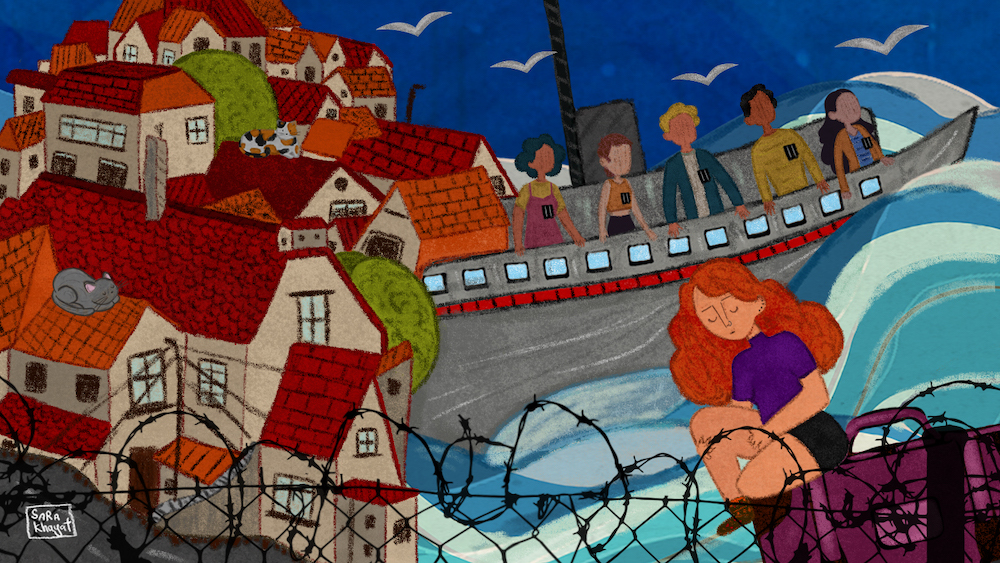
2. I was small in the middle of a big city, Istanbul. I thought that this city would hold me, unfortunately its high walls and crowded streets did not do it. People’s faces there were without features, hasty heads, their eyes open, but they could not see. Their hearts were closed. I knocked but no one opened, and no matter how much it was crowded around me, I was alone. Istanbul is a big prison for me or for any Syrian. Your hands are tied to your passport or your protection card, which is supposed to protect you as a refugee and to preserve your rights, but the truth is it is useless specially under a law which changes every day, but the change is never for your good. And prison, regardless of how long you have lived in it and no matter how sweet it is, it will not be a home .

3. In Lebanon, my home is the hug of my grandmother, Alia. Although I am supposed to be Lebanese because of my mother’s nationality. But she couldn’t give it to me because Lebanese law does not allow a mother to naturalize her husband or children. Actually, I was a stranger in Lebanon because of the law and because of the way some people treated me. Some people there harass me and treat me as responsible for the crimes of the Syrians. This is why I did not feel a homeland Lebanon.
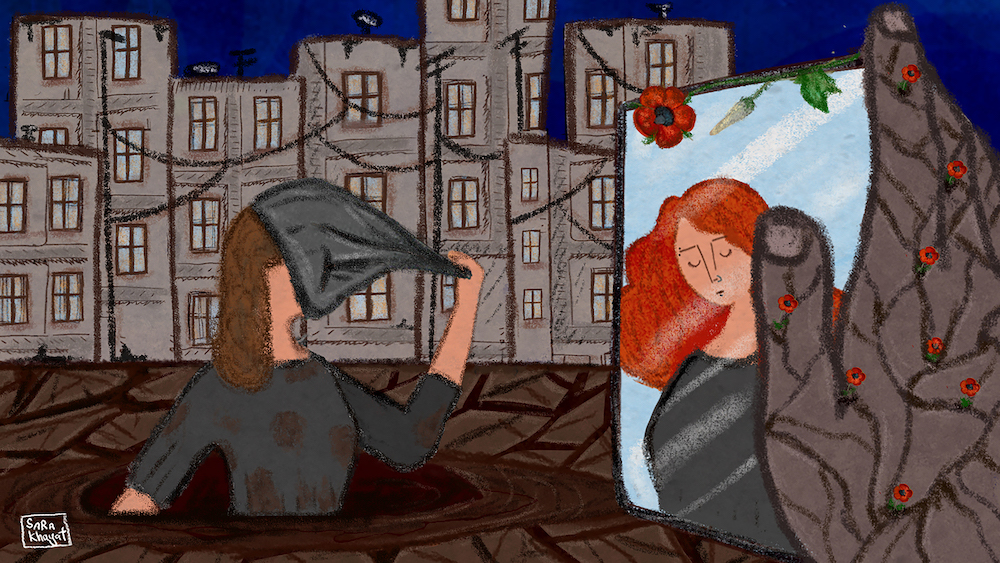
4. After years of living in Syria, I discovered that home was never there. I lived in Damascus, in a place that always imposed on me its habits and traditions, and reactionary concepts. It surrounded me with forbidding demands, I was under judgement all the time. But the revolution changed everything. It freed me and gave me a sense of belonging, and a sense that my existence has a meaning. Finally, I was without a mask when I shouted in that first demonstration I participated in 2011. At that time, I felt strong and I had a goal. I was with many people who were like me, searching for a new home. The revolution was for me a homeland as it was not a home for many others.
works in the exhibition
“My Journey With Niham: Eating is Pain not Pleasure” 1-4
- series of four digital drawing and painting
- dimensions: (84 x 119 cm approx.)
- venue: GALLERI ENTRANCE
“What’s the meaning of home for Syrian refugee woman in exile?” 1-4 (2023)
- series of four digital drawing and painting.
- dimensions: (84 x 119 cm approx.)
- venue: GALLERI ENTRANCE


 exhibition.school