‘we’ don’t need another biennale ‘here’?
Notes from the 2020 Curatorial Workshop | 23-26 June 2020 |Bucharest Biennale.
These are notes that might be of interest in thinking about what is at stake in both the Biennale framework, and in the workshop format and agenda itself. These notes are summary provocations to consider what are ‘we’ doing ‘here’ exactly? (This means to consider also who is the ‘we’ that is mentioned in this question, and where exactly is ‘here’ anyway?)
The Bucharest Biennale (BB) emerged in 2005, out of the context of a duo collaboration—Răzvan Ion and Eugen Rădescu—and their initiative Pavilion, a journal of politics and culture. The recent announcement that the 2022 iteration will be curated by some form of Artificial Intelligence has triggered strong reactions, something that this kind of media gambit is presumably designed to achieve. (An earlier pitch was the biennale curated by ‘the youngest curator ever to….’ ) Some of the links below connect to some fragments of this history and current media coverage.
The following extract from John Zarobell’s (2017) Art and the Global Economy gives a snapshot profile of BB, and it is followed by an extract from an article from seven years ago, that also provides a summary snapshot:

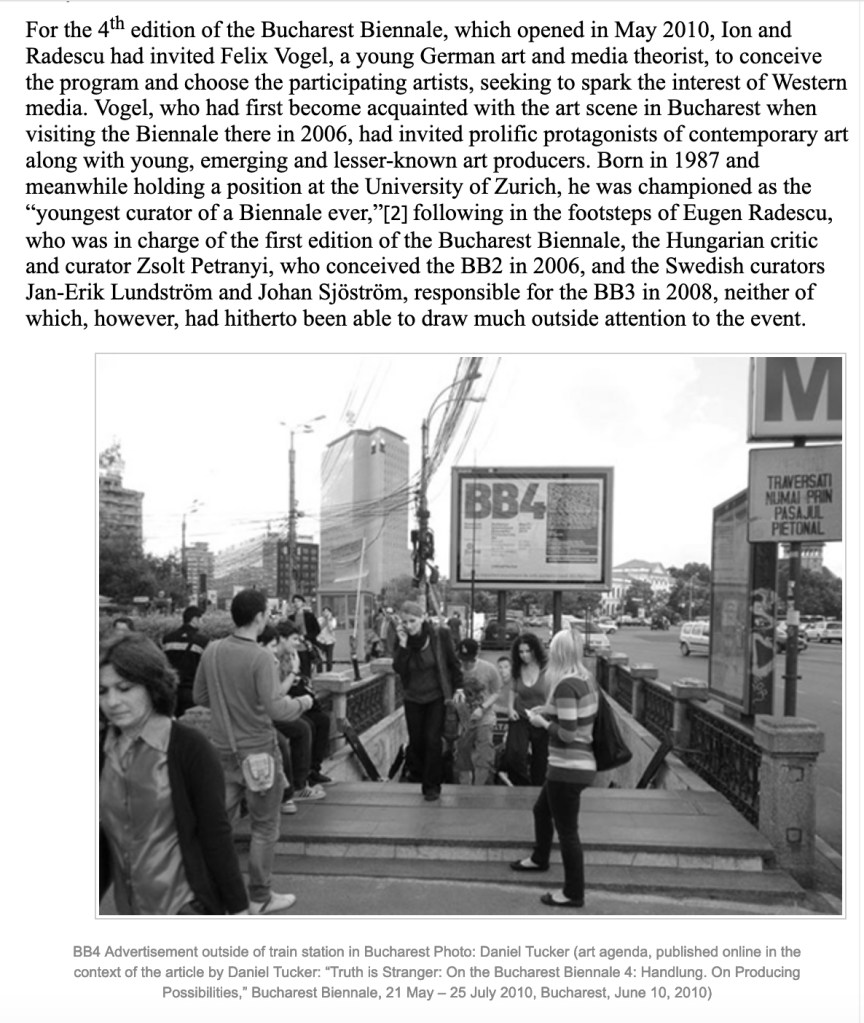
critical challenges
to the arts festival model
An issue that often arises with international semi-spectacle events— ‘cultural festivals’—that are place-branded (with a city or other location), and marketed ‘internationally-local’ is the question of how these art world devices operate in relation to local infrastructures, and to the cultural actualities and dynamics of the particular site/region claimed as their anchorage. There is also the question of how cultural dominance is rehearsed in centre/periphery, east/west, south/north, here/there, hub/relay geo-spatial power diagrams.
There is of course a familiar pattern of festivalization that concentrates resources in a high-profile short-run arc of activity but then creates a deficit of resources in the “down time” between moments of spectacle, art-tourism and ‘experience economy.’ There is the way in which some well positioned players and institutions capture such festivals and arrogate to themselves the right to author the ‘identity’ and cultural profile of a place, often subordinating, obscuring or out-manoeuvring other competing and differently positioned voices: Who takes agency? Who is barred from agency? Who is invited? Who is ignored? Who is funded? Who is de-funded? What is at stake? What is the legacy of an operation that orchestrates visibility and incites discourse? What is the relationship to the state? to the market? to the public sphere? to the question of ‘who has rights to the city’?
Other fault-lines pertain to the ways in which an internationally homogenous discourse of neoliberal cosmopolitanism seems to impose itself as a universal currency. It can be seen to do so by a superficial invocation of place-identity and difference, that feeds circuits of reputational distribution, consumption, and value capture … but moves on … ‘one place after another.’
These critical problematics of the ‘arts festival’, are not just an abstract set of general questions. These criticisms and concerns have specific focus and resonance in the context of both the current iteration of the Bucharest Biennale BB9, and of the recently announced BB10 with its well-publicized ‘AI curator.’
funding, NGOs and the missing state
The Non- Governmental Organizations (NGOs) that are not state agencies and not business ventures, are seen by many to have a specific role in the realization of “civil society” and the “public sphere.” These domains—civil society, the public sphere—are seen as dimensions of societal life that provide the possibility of autonomy (of self-rule) that exceeds (without totally escaping) the rule of the state and the rule of profit. This sector is sometimes referred to (using a US-American tax term) as the “NonProfits.”
Many arts organizations function in this mode, not as publicly founded institutions like some museums and universities, but as the initiative of private persons or cooperative associations. Some states and business ventures work closely with (and through) NGOs /non-profits. Some states simply withdraw and create the void into which volunteer initiatives step and take up the slack. There are a great variety of relationships possible between state and NGOs. These operate with different logics and priorities and in different geopolitical settings.
The funding of NGOs through corporate partnerships, sponsorships, grant aid, and other mechanisms of philanthropy, state, para-state, and inter-state (EU) funding creates a range of dependency relationships, that for some analysts and critics, undermine the seeming autonomy of NGOs. There are important structural conditions that have different histories and inflections in different national and regional contexts, and this is were different relationships of dominance become key. Writing almost a decade ago in a short text on “The NonProfit Sector,” Livia Pancu and Raluca Voinea identified this in respect of the cultural NGOs.
“With ‘peripheral,’ ‘turbo,’ or ‘wild’ capitalism well installed almost in all the countries of the former Eastern bloc—which is, however, still under pressure from the ‘center’ to align itself completely with the rest of the neoliberal world … communication both between cultural institutions and the contexts in which they operate and between these institutions and their funders, still takes place according to the old logic and relations of domination.”
The claim is made then that “an attitude common among Eastern European NGOs which claim to act chiefly in the interest of civil society while they end up representing the interests of different multinational companies and supranational bodies under the neoliberal hegemony. Such representation is normally achieved through the translation of financial capital and its ideology. This process of translation is made easy by the view, commonly accepted on both sides, that these countries need to catch up and establish relations with the international art scene. NGOs are trying to respond to this need by paying attention to their own conditions, which they sometimes reflect in their projects, through an inherent self-criticism that unveils that layer of horizontal communication. However, even when they manage to create a subversive discourse, they use it at best to predict what the funding bodies need to hear in order to continue providing them with their necessary grants—and in this case they fall again into the vertical relationship.”
This analysis of conditioning through funding, and creating a mirror of state and capital interests and agendas in dependent organisations, is one of the recurrent themes in the analysis of infrastructure and organizational culture in the arts sector. This analysis sits in tension then with Zarobell’s claim about BB, cited above: “Where there is no state support or key patron, the economic stakes may be low for a biennial, but the autonomy of the organizers is the payoff.”
making things worse?
It is perhaps worth emphasizing, that the discursive practices of seminars, workshops and conferences which may try to thematize these issues, within the framework of these festival events (such as this workshop) may be seen to aggravate matters entirely. These show-and-tell events can be seen to make matters worse, in as much as such ‘public programmes’ appear to perform a semblance of critical reflection, but actually leave the underlying socio-cultural processes and political effects unaltered and unchallenged. Indeed, they may be seen to provide legitimation and produce a thin ideological cover for business-as-usual, a kind of glossy wrapper tied around a bundle of tired old news of place marketing and publicity.
Even worse, this appearance of critical analysis can serve to disable public discourse by providing a false and rhetorically misleading version of critique, and distracting from other urgencies and so dissipate intellectual, artistic and activist energies.
What is to be done? We don’t need another biennale here? We are done talking? Is this a trick?
some sources
Gardner, Belinda Grace (2013) “Learning from Bucharest: Rethinking ‘white spots’ of art production in Central and Southeastern Europe” Seismopolite Journal of Art and Politics. A discussion of the 2010 Bucharest Biennale with specific reference to the curatorial arrangements for BB4, 5 and 6.”
Graziano, Valeria (2016) “‘Public Programming?’ Pedagogical Practices in a Missing Europe,” event report from research meeting Art and Design Research Centre, Middlesex University, posted on academia.edu
Silva, José da (2020) AI you ready for this? Bucharest Biennale to be curated by artificial intelligence called Jarvis. “The 2022 edition will exist in virtual reality and use data harvested from universities, galleries and art centres to select artists.”
The Bucharest Biennale Facebook Page
PAVILION the platform from which the Bucharest Biennale emerged in 2005: “PAVILION is a journal for politics and culture which by its name alludes to the relative temporary structure of contemporary culture. The journal features wide-ranging, multi-disciplinary content in each issue, by means of the varied formats of columns, essays, interviews and artistic projects. As a temporary structure allows a deconstruction of the systems supporting and underlying what has been called the ‘experience economy’. …. PAVILION – journal for politics and culture is the generator of BUCHAREST BIENNALE: BUCHAREST BIENNALE, PAVILION journal, PAVILION center & BUCHAREST FILM BIENNALE are projects of artphoto asc. BUCHAREST BIENNALE, PAVILION & BUCHAREST FILM BIENNALE are registred trade marks of artphoto asc. …All projects are devised and founded by Răzvan Ion & Eugen Rădescu.”
PAVILION Contemporary art & culture magazine / # 9CHAOS / READER OF BUCHAREST BIENNALE 2 The issue of Pavilion for the BB2.
Pancu, Livia and Voinea, Raluca (2011) “The NonProfit Sector,” in The Atlas of Transformation. The Atlas of Transformation is “a book with almost 900 pages. It is a sort of global guidebook of transformation processes. With structured entries, its goal is to create a tool for the intellectual grasping of the processes of social and political change in countries that call themselves “countries of transformation” or are described by this term.”
 exhibition.school