what—after all is said and done—is exhibition?
Notes from the 2020 Curatorial Workshop | 23-26 June 2020 |Bucharest Biennale.
Exhibiting can be thought of as the act or process of making visible, of showing, at least as a first point of departure. Exhibition can then also be described in terms of showing to a public. It becomes the operation of ‘going public’ or ‘making things public’. Rather that addressing itself to a pre-constituted ‘public,’ the exhibition can also be understood as producing a ‘public’ by its operation.
It can also be spoken of as a medium, as a means of articulation and expression—a channel through which something travels or is transmitted. Exhibition as medium also suggests the relationship with a tradition of practice, so that an exhibition becomes a point of relay within a network of exhibitions. Exhibition can be conceived of in terms of authorship as a ‘work’ or as an aesthetic ‘object’ (an event) in its own right. It may even be thought of by some as approaching the status of a ‘total’ work of art.
Exhibition can also be spoken of in terms of an institutional operation of organising ‘objects’ (that which is to be seen and known and recognized) and ‘subjects’ (those who are to see, to see objects laid out for them, addressing them, welcoming the viewer’s gaze, set up in its position waiting ready for the ‘subjects’ to step into their position and see…). This descriptive metaphor in terms of a ‘set up,’ a staging of viewing, leads towards the idea of exhibitions as a system, an arrangement.
In different terminologies, working with different emphases this arrangement can then be called an ‘apparatus’ or an ‘assemblage.’ Approached as an arrangement for organising a field of objects, producing the subject positions from which those objects may be ‘viewed’, producing the separation between a ‘viewer’ and the ‘view’, we can also speak of a generalized operation of looking, organizing and ranking objects and subjects.
If there is a different way of thinking in play, say moving away from the object/subject dichotomy towards ideas of process and entanglement, other ways of describing exhibition emerge. Instead of active viewers placed in opposition to passive things that wait ready to host a gaze projected upon their surfaces, this scene can be understood to unfold itself differently. We could speak of ‘agency’ as distributed, and adopt a different idea about how stuff exists and operates (ontology). Perhaps, exhibition could be described in very different terms than: ‘I look at it. It is there to be seen.’ Exhibition as a disposition of relations and processes where ‘stuff’ does ‘stuff’ to ‘stuff’… and where ‘viewers’ are re-described as a funny kind of self important ‘stuff’.
A different, though related version of this shift away from a dichotomy of subject/object, is apparent in Paul O’Neill’s co-productive model of the group exhibition: “In order to focus on the spatial context of the exhibitions, any implementation of thematic displays of related works is resisted, whereby selected artworks would have been forced to collectively adhere to a single theme. The artists were not there to illustrate any overarching subject, nor were the works arranged so as to demonstrate a coherent inter-textual relationship between one another. Instead, the gallery is a setting for the staging of spatial relations between works, and between viewers, with curating put forward as the activity that structures such experiences for the viewer and for the work.” (2014) “Co-productive Exhibition-Making and Three Principal Categories of Organisation: the Background, the Middle-ground and the Foreground“
There are clearly many different ways to proceed: the exhibition as machine of visibility; the exhibition as public sphere; the exhibition as medium; the exhibition as artistic utterance; the exhibition as institutional statement; the exhibition as staging site; the exhibition as spatial choreography; the exhibition as apparatus; the exhibition as assemblage (where the visual and discursive are not necessarily the primary matter of exhibition); and exhibition as a rhetorical operation addressing people, or modelling the world…. The list goes on…
When someone produces a description of what an exhibition is, or what it does, they can emphasize themes of visuality, public-ness, medium, artfulness, spatiality, categorising and ordering functions, the agency of non-human things, or the different ways these themes entangle.
Doreen Mendez for example proceeds as follows: “The question of spatial practices is critical in particular for curatorial politics because we are concerned with making something public. This is an inherently political question, and thus, also the exhibition is an inherently political project.” (2018) “Exhibiting as a Displaycing Practice, or, Curatorial Politics.”
no common essence?
Of course, one question to the different ways of talking about exhibiting and the exhibition, is whether the statements are functioning as descriptions or prescriptions. Another is whether there is an idea of an essential core to “the” exhibition, or whether exhibition is described as a flexible term covering multiple operations and objects. This wide field of operations encompasses many contiguous things—department store displays and natural history museum dioramas—placed beside each other under a common heading, but these things can be together without determining that they are identical. This is exhibition as a name for a wide gamut of processes that have resemblances and differences but no common essence.
Tony Bennett in his book (1988) The Birth of the Museum: History, Theory, Politic places the art exhibition in a wider category of institutions sharing family resemblances. Describing what he terms the ‘exhibitionary complex’, he points to the emergence of the 19th century art museum as “closely related to that of a wider range of institutions – history and natural science museums, dioramas and panoramas, national and, later, international exhibitions, arcades and department stores … these comprised an intersecting set of institutional and disciplinary relations which might be productively analysed as particular articulations of power and knowledge …” He also states: “It is, then, as a set of cultural technologies concerned to organize a voluntarily self-regulating citizenry that I propose to examine the formation of the exhibitionary complex.”
The two screen-grab images that follow (below) are taken respectively from an Australian commercial vendor providing services for corporate marketing and from a US-American educational reform advocacy website. They each provide ideas of ‘exhibition’ that seem to diverge prominently from the way the art exhibition is usually spoken about.
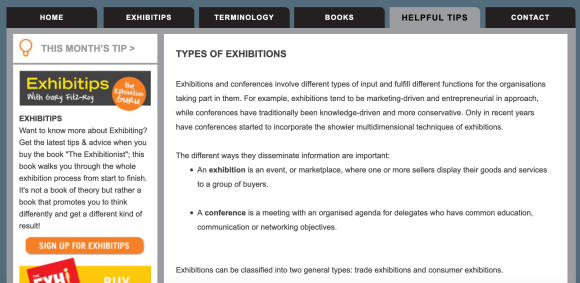

The commercial vendor’s website emphasizes the production of value through considered professional display strategies and techniques; and the educational lobbyists’ website emphasizes the active manifestation of competency—“demonstration”—the disclosure of something clearly, manifestly. Exhibition in education is linked to the active production of something external to the learner: a manifestation, that is linked to some notion of ‘experience.’
These themes of—’showing’ to make more value; and clear ‘demonstration’; clear showing; making things see-able—are not so alien to the ways in which art exhibitions may be understood. Even after many decades of expanded art practices, the exhibition is still arguably the primary mode through which art is affirmed as worthy of attention, as worth looking at as art.
the arc of exhibition
Patricia Mainardi describes the breach of protocol that the 19th Century French painter Gustav Courbet made, in deciding to erect his own temporary display of works for sale in the orbit of the universal expositions of 1855 and 1865. Mainardi notes that the word “exposition in both English and French … preserved the connotation of a didactic, morally instructive show. The word exhibition, on the other hand, while meaning in English simply a show, assumed in nineteenth century France a pejorative connotation of ostentation and immodesty. A commercial enterprise, shop window display, would be an exhibition, just as personal behaviour we today would label exhibitionist. This negative attitude towards anything commercial derived from traditional aristocratic disdain for commerce, which, in the nineteenth century, was identified with England, the leading commercial power among nations; hence the pejorative use of the English word exhibition.”
About a century later Daniel Buren expressed a different concern, in the often-repeated quote: “The subject of exhibitions tends more and more to be not so much the exhibition of works of art, as the exhibition of the exhibition as a work of art.”
In the interim period a range of exhibitionary practices had evolved, and among them a prominent paradigm was that of the “white cube.” Elena Filipovic provides a clear summary of Brian O’Doherty’s analysis when she wrotes:
”Windows were banished so that the semblance of an outside world—daily life, the passage of time, in short, context—disappeared; overhead lights were recessed and emitted a uniform, any-given-moment-in-the-middle-of-the-day glow; noise and clutter were suppressed; a general sobriety reigned. A bit like its cinematic black-box pendant, the museum’s galleries unequivocally aimed to extract the viewer from “the world.” For this and other reasons, the minimal frame of white was thought to be “neutral” and “pure,” an ideal support for the presentation of an art unencumbered by architectural, decorative, or other distractions. The underlying fiction of this whitewashed space is not only that ideology is held at bay, but also that the autonomous works of art inside convey their meaning in uniquely aesthetic terms. The form for this fiction quickly became a standard, a universal signifier of modernity, and eventually was designated the “white cube.” (2014) “The Global White Cube”
exhibition as genre
Writing almost three decades after Tony Bennett’s “Exhibitionary Complex”, Vincent Normand, describing a research project on the exhibition as an apparatus within (colonial-)modernity describes the wider context of his concerns with the history of exhibition and the wish to study exhibition beyond the internalist concerns of the art field:
“Nowadays, while the exhibition enjoys a state of hegemony among the forms of democratic access to art (to such an extent that contemporary art, in its most symptomatic sense, could be reduced to its privileged mode of presentation, its exhibition), its history is clearly undergoing renewed interest. In the many symposia, publications, and journals dedicated to the art exhibition, its history is often mobilized either as an object of professional hyper-self-reflexivity for curators, or as an institutional narrative based on art-historical markers alone, producing a narration of the history of exhibitions that, more often than not, terminates in exercises of legitimation, leaving its actual hegemony unquestioned.” (2016) “Theater, Garden, Bestiary: Filipa Ramos, Vincent Normand, and Tristan Garcia in Conversation”
Normand defines his strategy through the term “genre”, using this to point to the way exhibition emerges as a convention and strategy of knowledge work: “it seemed important for us to avoid mobilizing exhibitions as a form of art, as is usually the case, but to maintain a dialectical engagement with the exhibition as a genre, meaning, as a generic object of modernity, in order to grasp it in a fully historical way.” Within the view of the exhibition as a generic device he can then speak of “the positivist and objectivist forms of rationality that historically coded the institutions of exhibition that have emerged throughout scientific modernity (anatomical theaters, natural history collections, zoological gardens).”
A feature of all the above materials, is that they are very generic. These fragments deal with ways of speaking/writing about what exhibition is, but these notes are not writing/speaking in relation to, in contact with, a specific exhibition: Here, look at this one!
one last talking point…
Exhibition has been adopted here as a talking point. Exhibitions have long operated as incitements, prompts to speak and to write.
“The early Salons of the French Royal Academy spawned broader participation in critical discourse by the general public not only by providing an egalitarian site for the expression of personal opinions, but by theorizing the legitimacy of amateur response in a field previously limited to experts. Theorists of the period encouraged those with little or no technical experience in art to speak their minds about paintings, in pursuit of taste and individual distinction. Paradoxically, pursuing critical autonomy and individuality in this way entailed the assimilation of consensus values and protocols. Thus, the Salons prefigured the modern ethic of aesthetic self-expression that channels the pursuit of individuality and personal distinction into social order and hierarchy.”
Ray, William (2004) “Talking About Art: the French Royal Academy Salons and the Formation of the Discursive Citizen” in Eighteenth-Century Studies, Volume 37, Number 4, Summer, pp. 527-552. The Johns Hopkins University Press
Is there anything particular at stake in asking the general question: “What is exhibition”?
 exhibition.school